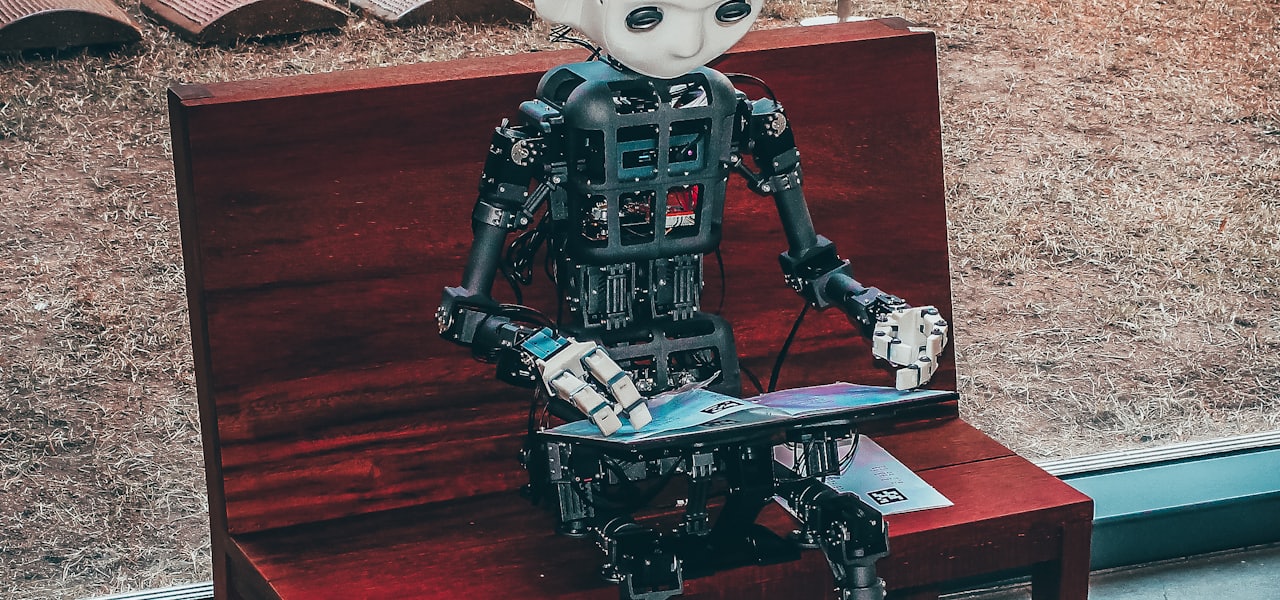
Natural-language user interface (LUI or NLUI) is a type of computer human interface where linguistic phenomena such as verbs, phrases and clauses act as UI controls for creating, selecting and modifying data in software applications. Chatbots are a common implementation of natural-language interfaces, enabling users to interact with software through conversational text or speech. In interface design, natural-language interfaces are sought after for their speed and ease of use, but most suffer the challenges to understanding wide varieties of ambiguous input. Natural-language interfaces are an active area of study in the field of natural-language processing and computational linguistics. An intuitive general natural-language interface is one of the active goals of the Semantic Web. Text interfaces are "natural" to varying degrees. Many formal (un-natural) programming languages incorporate idioms of natural human language. Likewise, a traditional keyword search engine could be described as a "shallow" natural-language user interface. == Overview == A natural-language search engine would in theory find targeted answers to user questions (as opposed to keyword search). For example, when confronted with a question of the form 'which U.S. state has the highest income tax?', conventional search engines ignore the question and instead search on the keywords 'state', 'income' and 'tax'. Natural-language search, on the other hand, attempts to use natural-language processing to understand the nature of the question and then to search and return a subset of the web that contains the answer to the question. If it works, results would have a higher relevance than results from a keyword search engine, due to the question being included. == History == Prototype Nl interfaces had already appeared in the late sixties and early seventies. SHRDLU, a natural-language interface that manipulates blocks in a virtual "blocks world" Lunar, a natural-language interface to a database containing chemical analyses of Apollo 11 Moon rocks by William A. Woods. Chat-80 transformed English questions into Prolog expressions, which were evaluated against the Prolog database. The code of Chat-80 was circulated widely, and formed the basis of several other experimental Nl interfaces. An online demo is available on the LPA website. ELIZA, written at MIT by Joseph Weizenbaum between 1964 and 1966, mimicked a psychotherapist and was operated by processing users' responses to scripts. Using almost no information about human thought or emotion, the DOCTOR script sometimes provided a startlingly human-like interaction. An online demo is available on the LPA website. Janus is also one of the few systems to support temporal questions. Intellect from Trinzic (formed by the merger of AICorp and Aion). BBN's Parlance built on experience from the development of the Rus and Irus systems. IBM Languageaccess Q&A from Symantec. Datatalker from Natural Language Inc. Loqui from BIM Systems. English Wizard from Linguistic Technology Corporation. == Challenges == Natural-language interfaces have in the past led users to anthropomorphize the computer, or at least to attribute more intelligence to machines than is warranted. On the part of the user, this has led to unrealistic expectations of the capabilities of the system. Such expectations will make it difficult to learn the restrictions of the system if users attribute too much capability to it, and will ultimately lead to disappointment when the system fails to perform as expected as was the case in the AI winter of the 1970s and 80s. A 1995 paper titled 'Natural Language Interfaces to Databases – An Introduction', describes some challenges: Modifier attachment The request "List all employees in the company with a driving licence" is ambiguous unless you know that companies can't have driving licences. Conjunction and disjunction "List all applicants who live in California and Arizona" is ambiguous unless you know that a person can't live in two places at once. Anaphora resolution resolve what a user means by 'he', 'she' or 'it', in a self-referential query. Other goals to consider more generally are the speed and efficiency of the interface, in all algorithms these two points are the main point that will determine if some methods are better than others and therefore have greater success in the market. In addition, localisation across multiple language sites requires extra consideration - this is based on differing sentence structure and language syntax variations between most languages. Finally, regarding the methods used, the main problem to be solved is creating a general algorithm that can recognize the entire spectrum of different voices, while disregarding nationality, gender or age. The significant differences between the extracted features - even from speakers who says the same word or phrase - must be successfully overcome. == Uses and applications == The natural-language interface gives rise to technology used for many different applications. Some of the main uses are: Dictation, is the most common use for automated speech recognition (ASR) systems today. This includes medical transcriptions, legal and business dictation, and general word processing. In some cases special vocabularies are used to increase the accuracy of the system. Command and control, ASR systems that are designed to perform functions and actions on the system are defined as command and control systems. Utterances like "Open Netscape" and "Start a new xterm" will do just that. Telephony, some PBX/Voice Mail systems allow callers to speak commands instead of pressing buttons to send specific tones. Wearables, because inputs are limited for wearable devices, speaking is a natural possibility. Medical, disabilities, many people have difficulty typing due to physical limitations such as repetitive strain injuries (RSI), muscular dystrophy, and many others. For example, people with difficulty hearing could use a system connected to their telephone to convert a caller's speech to text. Embedded applications, some new cellular phones include C&C speech recognition that allow utterances such as "call home". This may be a major factor in the future of automatic speech recognition and Linux. Below are named and defined some of the applications that use natural-language recognition, and so have integrated utilities listed above. === Ubiquity === Ubiquity, an add-on for Mozilla Firefox, is a collection of quick and easy natural-language-derived commands that act as mashups of web services, thus allowing users to get information and relate it to current and other webpages. === Wolfram Alpha === Wolfram Alpha is an online service that answers factual queries directly by computing the answer from structured data, rather than providing a list of documents or web pages that might contain the answer as a search engine would. It was announced in March 2009 by Stephen Wolfram, and was released to the public on May 15, 2009. === Siri === Siri is an intelligent personal assistant application integrated with operating system iOS. The application uses natural language processing to answer questions and make recommendations. Siri's marketing claims include that it adapts to a user's individual preferences over time and personalizes results, and performs tasks such as making dinner reservations while trying to catch a cab. === Others === Ask.com – The original idea behind Ask Jeeves (Ask.com) was traditional keyword searching with an ability to get answers to questions posed in everyday, natural language. The current Ask.com still supports this, with added support for math, dictionary, and conversion questions. Braina – Braina is a natural language interface for Windows OS that allows to type or speak English language sentences to perform a certain action or find information. GNOME Do – Allows for quick finding miscellaneous artifacts of GNOME environment (applications, Evolution and Pidgin contacts, Firefox bookmarks, Rhythmbox artists and albums, and so on) and execute the basic actions on them (launch, open, email, chat, play, etc.). hakia – hakia was an Internet search engine. The company invented an alternative new infrastructure to indexing that used SemanticRank algorithm, a solution mix from the disciplines of ontological semantics, fuzzy logic, computational linguistics, and mathematics. hakia closed in 2014. Lexxe – Lexxe was an Internet search engine that used natural-language processing for queries (semantic search). Searches could be made with keywords, phrases, and questions, such as "How old is Wikipedia?" Lexxe closed its search engine services in 2015. Pikimal – Pikimal used natural-language tied to user preference to make search recommendations by template. Pikimal closed in 2015. Powerset – On May 11, 2008, the company unveiled a tool for searching a fixed subset of Wikipedia using conversational phrases rather than keywords. On July 1, 2008, it was purchased by
Kuaishou
Kuaishou Technology is a Chinese publicly traded partly state-owned holding company based in Haidian District, Beijing, that was founded in 2011 by Hua Su (Chinese: 宿华) and Cheng Yixiao (Chinese: 程一笑). The company, listed on the Hong Kong Stock Exchange, is known for developing a mobile app for sharing users' short videos, a social network, and video special effects editor. The app is known as Kwai in many countries outside of China. It is also known as Snack Video in India, Pakistan and Indonesia. == Ownership and governance == Kuaishou's overseas team is led by the former CEO of the application 99, and staff from Google, Facebook, Netflix, and TikTok were recruited to lead the company's international expansion. The China Internet Investment Fund, a state-owned enterprise controlled by the Cyberspace Administration of China, holds a golden share ownership stake in Kuaishou. == History == Kuaishou is China's first short video platform that was developed in 2011 by engineer Hua Su and Cheng Yixiao. Prior to co-founding Kuaishou, Su Hua had worked for both Google and Baidu as a software engineer. The company is headquartered in Haidian District, Beijing. Kuaishou's predecessor "GIF Kuaishou" was founded in March 2011. GIF Kuaishou was a mobile app with which users could make and share GIF pictures. In 2013, Kuaishou became a short-video social platform. By 2013, the app had reached 100 million daily users. By 2019, it had exceeded 200 million active daily users. In March 2017, Kuaishou closed a US$350 million investment round that was led by Tencent. In January 2018, Forbes estimated the company's valuation to be US$18 billion. In April 2018, Kuaishou's app was briefly banned from Chinese app stores after China Central Television (CCTV) reported on the platform popularizing videos of teenage mothers. In 2019, the company announced a partnership with the People's Daily, an official newspaper of the Central Committee of the Chinese Communist Party, to help it experiment with the use of artificial intelligence in news. In June 2020, following the start of the 2020–2021 China–India skirmishes, the Government of India banned Kwai along with 58 other apps, citing "data and privacy issues". In January 2021, Kuaishou announced it was planning an initial public offering (IPO) to raise approximately US$5 billion. Kuaishou's stock completed its first day of trading at $300 Hong Kong dollars (HKD) (US$38.70), more than doubling its initial offer price, and causing its market value to rise to over $1 trillion HKD (US$159 billion). In February 2021, Kuaishou made a debut on the Hong Kong Stock Exchange, with its shares soaring by 194% at the opening. The company subsequently encountered major setbacks as a result of heightened regulatory restrictions on Chinese internet firms, which contributed to its share price falling by nearly 80% from its post-IPO peak. By December 2021, Kuaishou announced a major reorganization, including the layoff of 30% of its staff, primarily targeting mid-level employees earning an annual salary of $157,000 or more. This restructuring aimed to cut costs and mitigate financial losses. In October 2022, state-owned Beijing Radio and Television Station took a minority ownership stake in Kuaishou. In April 2024, a Financial Times article citing current and former Kuaishou employees stated that the company has been running an ageist redundancy programme known internally as "Limestone", culling workers in their mid-30s. In June 2024, Kuaishou and the Sichuan international communication center launched a branch center in São Paulo, Brazil. In June 2024, Kuaishou released its diffusion transformer text-to-video model, Kling, which they claimed could generate two minutes of video at 30 frames per second and in 1080p resolution. The model has been compared to that of OpenAI's Sora text-to-video model. It is accessible to the public on Kuaishou's video editing app KwaiCut via signing up for a waitlist with a Chinese phone number. In December 2025, Kuaishou came under a cyberattack which led to a temporary influx of violent and pornographic content. == Popularity == As of 2019, it had a worldwide user base of over 200 million, leading the "Most Downloaded" lists of the Google Play and Apple App Store in eight countries, such as Brazil, where it was introduced in 2019. Its main short-video platform competitor was Douyin, which is known as TikTok outside China. Compared to Douyin, Kuaishou is more popular with older users living outside China's Tier 1 cities. Its initial popularity came from videos of Chinese rural life. The app is particularly well known for its "rustic" aesthetic and is popular among rural people. Kuaishou also relied more on e-commerce revenue than on advertising revenue compared to its main competitor. == Reception == Kwai (as the app is called outside of China) was banned in India in 2020 along with other short video apps like TikTok. Kuaishou then released the clone SnackVideo, which was subsequently also banned. The app is one of the most popular social media platforms in Brazil, where Kuaishou partnered with creators to make telenovela style content, and appeals to football fans by working with football teams CR Flamengo and Santos FC and sponsoring the tournament Copa América. Kwai was notable in Brazil for spreading information (and misinformation) about the COVID-19 vaccine and political misinformation. === Manjiao Wenhua === "Manjiao wenhua" (慢脚文化) is a sarcasm term on Chinese internet on the unethical or illegal contents on Kuaishou. State broadcaster China Central Television (CCTV) reported that many contents are about child pregnancy. "Dating, pregnancy, bearing a child...these are strictly prohibited in the real time by a minor, but these contents can easily shown to audiences here." In addition, many students from primary or secondary schools make a pose of smoking. Wang Zhenhui (王贞会) from CUPSL stated that these kinds of bad values will give negative effects to the minors.
Hive (artificial intelligence company)
Hive is an American artificial intelligence company offering machine learning models via APIs to enterprise customers. Hive uses around 700,000 gig workers to train data for its models through its Hive Work app. One of Hive's major offerings is to provide automated content moderation services. == Products == Hive is reported to have been engaged to provide content moderation services to social news aggregator Reddit, Giphy, BeReal, Donald Trump-affiliated social network Truth Social, and on online chat website Chatroulette. Parler, after its shutdown by content service providers in early 2021 due to a lack of content moderation, integrated with Hive and was allowed back in the App Store. Hive's content moderation models have been leveraged widely in the livestreaming industry, where the cost of human moderation is high. Hive's models have also been used in events such as the Super Bowl and March Madness, and its contextual advertising models used by NBC Universal and Vevo. Hive provides APIs to detect deepfakes and AI-generated artwork. In early 2023, Hive released a free demo text classifier intended to detect AI-generated text. Mark Hachman at PC World rated Hive's classifier favorably and found it more reliable than OpenAI's AI text classifier. == History == Hive was founded by Kevin Guo and Dmitriy Karpman, and in April 2021, announced $85M in new capital at a valuation of $2 billion.
Open Neural Network Exchange
The Open Neural Network Exchange (ONNX) [ˈɒnɪks] is an open-source artificial intelligence ecosystem of technology companies and research organizations that establish open standards for representing machine learning algorithms and software tools to enable a standard format for representing machine learning models. ONNX is available on GitHub. == History == ONNX was originally named Toffee and was developed by the PyTorch team at Facebook. In September 2017 it was renamed to ONNX and announced by Facebook and Microsoft. Later, IBM, Huawei, Intel, AMD, Arm and Qualcomm announced support for the initiative. In October 2017, Microsoft announced that it would add its Cognitive Toolkit and Project Brainwave platform to the initiative. In November 2019 ONNX was accepted as graduate project in Linux Foundation AI. In October 2020 Zetane Systems became a member of the ONNX ecosystem. == Intent == The initiative targets: === Framework interoperability === Enable developers to move machine learning models between different frameworks, which may be used at different stages of the development process, such as training, architecture design, or deployment on mobile devices. === Shared optimization === Provide a common representation that can be used by hardware vendors and other developers to apply optimizations to artificial neural network models across multiple machine learning frameworks. == Contents == ONNX provides definitions of an extensible computation graph model, built-in operators and standard data types, focused on inferencing (evaluation).. The container format is Protocol Buffers. Each computation dataflow graph is a list of nodes that form an acyclic graph. Nodes have inputs and outputs. Each node is a call to an operator. Metadata documents the graph. Built-in operators are to be available on each ONNX-supporting framework. ONNX models can be trained in a single framework, such as PyTorch or TensorFlow, and then exported to ONNX. This format allows models to be transferred from the training framework to other environments for testing or deployment. Once a model is in ONNX format, it can be executed in different runtime systems or on various hardware platforms, such as GPUs or specialized AI accelerators. Using a common format enables the same model representation to be used across multiple systems and frameworks.
Google Nest
Google Nest, formerly branded Google Home, is a line of smart home products including smart speakers, smart displays, streaming devices, thermostats, smoke detectors, routers and security systems including smart doorbells, cameras and smart locks. The Nest brand name was originally owned by Nest Labs, co-founded by former Apple engineers Tony Fadell and Matt Rogers in 2010. Its flagship product, which was the company's first offering, is the Nest Learning Thermostat, introduced in 2011. The product is programmable, self-learning, sensor-driven, and Wi-Fi-enabled: features that are often found in other Nest products. It was followed by the Nest Protect smoke and carbon monoxide detectors in October 2013. After its acquisition of Dropcam in 2014, the company introduced its Nest Cam branding of security cameras beginning in June 2015. The company quickly expanded to more than 130 employees by the end of 2012. Google acquired Nest Labs for US$3.2 billion in January 2014, when the company employed 280. As of late 2015, Nest employs more than 1,100 and added a primary engineering center in Seattle. After Google reorganized itself under the holding company Alphabet Inc., Nest operated independently of Google from 2015 to 2018. However, in 2018, Nest was merged into Google's home-devices unit led by Rishi Chandra, effectively ceasing to exist as a separate business. In July 2018, it was announced that all Google Home electronics products will henceforth be marketed under the brand Google Nest. == History == === Nest Labs before acquisition by Google === Nest Labs was founded in 2010 by former Apple engineers Tony Fadell and Matt Rogers. The idea came when Fadell was building a vacation home and found all of the available thermostats on the market to be inadequate, motivated to bring something better on the market. Early investors in Nest Labs included Shasta Ventures and Kleiner Perkins. === Acquisition by Google of Nest Labs, Dropcam, and Revolv === On January 13, 2014, Google announced plans to acquire Nest Labs for $3.2 billion in cash. Google completed the acquisition the next day, on January 14, 2014. The company would operate independently from Google's other businesses. In June 2014, it was announced that Nest would buy camera startup Dropcam for $555 million. With the purchase, Dropcam became integrated with other Nest products; if the Protect alarm is triggered, the Dropcam can automatically start recording, and the Thermostat can use Dropcam to sense for motion. In September 2014, the Nest Thermostat and Nest Protect (a smoke alarm) became available in Belgium, France, Ireland, and the Netherlands. Initially, they were sold in approximately 400 stores across Europe, with another 150 stores to be added by the end of the year. In June 2015, the new Nest Cam, replacing the Dropcam, was announced, together with the second generation of the Nest Protect; there were internal reports that sales of the rebranded camera fell. On October 24, 2014, Nest both acquired the hub service Revolv, and discontinued its product line, gaining the expertise of Revolv's staff. === Nest as a subsidiary of Alphabet Inc. === In August 2015, Google announced that it would restructure its operations under a new parent company, Alphabet Inc., with Nest being separated from Google as a subsidiary of the new holding company. In January 2016, some Nest thermostats stopped working, a fault attributed to a software update from two weeks earlier. There were no lawsuits, individual or class-action, due to an arbitration clause in the contract. All Revolv smart hubs, costing several hundred dollars, were deliberately remotely bricked on May 15, 2016; notice was posted on the company's website in February. The story became news on April 4. The "lifetime subscription" to Revolv's online service, which had been sold with the hub, was defined by Nest to be the lifetime of the device, which ended May 15. Nest's decision to brick the hubs, and its "acerbic" corporate culture, faced substantial criticism from within Google/Alphabet and in press coverage. Many of Nest's staffers came from Dropcam and Revolv, and by November 2015, about 70 of about 1000 staffers had quit, causing management concern. Some countermeasures had been taken in takeover deals, to financially discourage senior people from leaving before set dates. Of the ~100 Dropcam staffers, about half had left by March 2016, when former Dropcam CEO Greg Duffy (who left 8 months after the takeover) wrote a post openly regretting selling his company to Nest. He stated that about 500 people had left (of a 1200-person staff). On June 6, 2016, Tony Fadell, the Nest CEO, announced in a blog post that he was leaving the company he founded with Matt Rogers and stepping into an "advisory" role. At this point the Nest acquisition was described by some press as a "disaster" for Google. As of mid-June 2016, Nest's problems were considered symptomatic of the limited market for home automation. According to Frank Gillet of Forrester Research, only 6% of American households possessed internet-connected devices such as appliances, home-monitoring systems, speakers, or lighting. He also predicted this percentage would grow to only 15% by 2021. Furthermore, 72% of respondents in a 2016 British survey conducted by Pricewaterhouse Coopers did not foresee adopting smart-home technology over the next two to five years. === Nest as a part of Google hardware division === On February 7, 2018, it was announced by hardware head Rick Osterloh that Nest had been merged into Google's hardware division, directly alongside units such as Google Home and Chromecast. It would retain its separate Palo Alto headquarters, but Nest CEO Marwan Fawaz would now report to Osterloh, and there were plans for tighter integration with Google platforms and software such as Google Assistant in future products. Shortly after the announcement, co-founder and chief product officer Matt Rogers announced his plans to leave the company. On July 18, 2018, Nest CEO Marwan Fawaz stepped down. Nest was merged with Google's home devices team, led by Rishi Chandra. During the Google I/O keynote on May 7, 2019, it was announced that Google Nest will now serve as the blanket branding for all of Google's home products. The Google Home Hub was retroactively renamed Google Nest Hub, while a new and larger version of the product is now available called the Nest Hub Max with both a larger screen and an amplified speaker, for a greater low-end audio experience. Also, product lines such as Chromecast, Google Home, and Google Wifi will now be marketed under the Google Nest brand. In addition, Nest began to deprecate its own internal platforms, announcing the discontinuation of the existing "Works with Nest" program in favor of Google Assistant going forward, and pushing users to migrate themselves from Nest's account system to Google accounts. Google published Nest-specific privacy information outlining a commitment to transparency, not selling personal information, and giving users control of their data. In February 2019, a privacy incident affecting the Google Nest Guard system came about. The controversy stemmed from the fact that Nest Guard, a security device that was part of the Nest Secure system, contained a hidden microphone that was not disclosed in any product specifications. It resulted in a public relations failure. === Partnership with ADT === In August 2020 Google announced intent to invest $450 million in ADT Inc. for a 6.6% stake in the company. The companies intend to integrate Nest devices with ADT's security monitoring services and eventually make them the “cornerstone of ADT’s smart home offering”, according to Nest. Upon the announcement, the shares of ADT doubled in value and hit all-time high of $17.21. === Use with Amazon Alexa === As of mid-2022, Google's newer Nest cameras will now work with Amazon Alexa devices such as Amazon Echo Show, Fire TV, and Fire Tablet to view captured security camera footage. === End of support policies === On October 25, 2025, software support was ended for the 1st and 2nd generation Nest Learning Thermostats. In addition, most of the smart functionality including the Home Away features, notifications, and carbon monoxide sensor became inoperative as they were dependent on connection with Google servers. By mid-November, third-party software solutions became available to restore functionality to affected thermostats. == Products == === Nest Learning Thermostat === The Nest Learning Thermostat is an electronic, programmable, and self-learning Wi-Fi-enabled thermostat that optimizes heating and cooling of homes and businesses to conserve energy. It is based on a machine-learning algorithm: for the first weeks users have to regulate the thermostat in order to provide the reference data set. Nest can then learn people's schedules, at which temperature they are used to and when. Using built-in sensors and phones' locations it can
List of chatbots
A chatbot is a software application or web interface that is designed to mimic human conversation through text or voice interactions. Modern chatbots are typically online and use generative artificial intelligence systems that are capable of maintaining a conversation with a user in natural language and simulating the way a human would behave as a conversational partner. Such chatbots often use large language models (LLMs) and natural language processing, but simpler chatbots have existed for decades. == LLM chatbots == == General chatbots == == Historical chatbots ==
Cerebellar model articulation controller
The cerebellar model arithmetic computer (CMAC) is a type of neural network based on a model of the mammalian cerebellum. It is also known as the cerebellar model articulation controller. It is a type of associative memory. The CMAC was first proposed as a function modeler for robotic controllers by James Albus in 1975 (hence the name), but has been extensively used in reinforcement learning and also as for automated classification in the machine learning community. The CMAC is an extension of the perceptron model. It computes a function for n {\displaystyle n} input dimensions. The input space is divided up into hyper-rectangles, each of which is associated with a memory cell. The contents of the memory cells are the weights, which are adjusted during training. Usually, more than one quantisation of input space is used, so that any point in input space is associated with a number of hyper-rectangles, and therefore with a number of memory cells. The output of a CMAC is the algebraic sum of the weights in all the memory cells activated by the input point. A change of value of the input point results in a change in the set of activated hyper-rectangles, and therefore a change in the set of memory cells participating in the CMAC output. The CMAC output is therefore stored in a distributed fashion, such that the output corresponding to any point in input space is derived from the value stored in a number of memory cells (hence the name associative memory). This provides generalisation. == Building blocks == In the adjacent image, there are two inputs to the CMAC, represented as a 2D space. Two quantising functions have been used to divide this space with two overlapping grids (one shown in heavier lines). A single input is shown near the middle, and this has activated two memory cells, corresponding to the shaded area. If another point occurs close to the one shown, it will share some of the same memory cells, providing generalisation. The CMAC is trained by presenting pairs of input points and output values, and adjusting the weights in the activated cells by a proportion of the error observed at the output. This simple training algorithm has a proof of convergence. It is normal to add a kernel function to the hyper-rectangle, so that points falling towards the edge of a hyper-rectangle have a smaller activation than those falling near the centre. One of the major problems cited in practical use of CMAC is the memory size required, which is directly related to the number of cells used. This is usually ameliorated by using a hash function, and only providing memory storage for the actual cells that are activated by inputs. == One-step convergent algorithm == Initially least mean square (LMS) method is employed to update the weights of CMAC. The convergence of using LMS for training CMAC is sensitive to the learning rate and could lead to divergence. In 2004, a recursive least squares (RLS) algorithm was introduced to train CMAC online. It does not need to tune a learning rate. Its convergence has been proved theoretically and can be guaranteed to converge in one step. The computational complexity of this RLS algorithm is O(N3). == Hardware implementation infrastructure == Based on QR decomposition, an algorithm (QRLS) has been further simplified to have an O(N) complexity. Consequently, this reduces memory usage and time cost significantly. A parallel pipeline array structure on implementing this algorithm has been introduced. Overall by utilizing QRLS algorithm, the CMAC neural network convergence can be guaranteed, and the weights of the nodes can be updated using one step of training. Its parallel pipeline array structure offers its great potential to be implemented in hardware for large-scale industry usage. == Continuous CMAC == Since the rectangular shape of CMAC receptive field functions produce discontinuous staircase function approximation, by integrating CMAC with B-splines functions, continuous CMAC offers the capability of obtaining any order of derivatives of the approximate functions. == Deep CMAC == In recent years, numerous studies have confirmed that by stacking several shallow structures into a single deep structure, the overall system could achieve better data representation, and, thus, more effectively deal with nonlinear and high complexity tasks. In 2018, a deep CMAC (DCMAC) framework was proposed and a backpropagation algorithm was derived to estimate the DCMAC parameters. Experimental results of an adaptive noise cancellation task showed that the proposed DCMAC can achieve better noise cancellation performance when compared with that from the conventional single-layer CMAC. == Summary ==